
Blog
Introducing monoprop: propagation at escape velocity
We are releasing monoprop, an open-source engine for classically simulating and variationally optimising quantum circuits. monoprop stands for monomial propagation, the technique the library is built on. It is also a shorthand for monopropellant rockets, given how fast it runs. It is a C++ library with a Python interface that implements both Majorana propagation, a method developed by Algorithmiq’s researchers (arXiv:2503.18939), and Pauli propagation (arXiv:2505.21606). To the best of our knowledge, monoprop is the only package that does both. monoprop is the engine behind several of our recent results, which we describe below.
How it works
Most classical simulators store the quantum state, and the memory cost grows quickly with system size. monoprop stores the observable and propagate it through the circuit in the Heisenberg picture, expanding it in the Majorana basis as a sum of weighted monomials. It also supports the Schrödinger picture, propagating the state forward while the observable is held fixed.
The method works because high-weight monomials are exponentially unlikely to contribute to an expectation value, and their unwanted backflow to lower weights is quadratically suppressed in system size. Truncating them is therefore cheap, and the truncation error is bounded. What remains is a compact representation of the operator.
The library scales from a laptop to a HPC cluster through shared-memory threading and multi-node MPI.
ADAPT-VMPE: Enabling an Award-Winning Quantum Simulation
We developed monoprop to enable our chemistry pipeline. Our ADAPT-VMPE algorithm (arXiv:2603.23444) uses Majorana propagation to generate quantum circuits that iteratively approximate the ground states of molecular Hamiltonians. It comes with affordable approximation error, and its cost is polynomial in both the qubit count and the number of iterations. Because monoprop makes the underlying propagation fast enough to run inside an optimisation loop, we could apply ADAPT-VMPE to real chemistry rather than toy models, constructing up to 100-qubit ansätze for simulating the ground and lowest excited states of TLD-1433, a strongly correlated photosensitizer currently in human clinical trials.
This work earned Algorithmiq the $2 million Wellcome Leap Quantum for Bio prize, awarded for the winning quantum-classical workflow to simulate complex drug-activation pathways on current hardware, up to 100 qubits on IBM systems, in the context of photodynamic therapy, a light-activated cancer treatment.
What sets us apart
monoprop is the only package that implements both Majorana and Pauli propagation.
With our implementation, cost drops by a factor of , where is the number of qubits with respect to PauliPropagation.jl. We are preparing a paper to discuss the insights that made this possible.
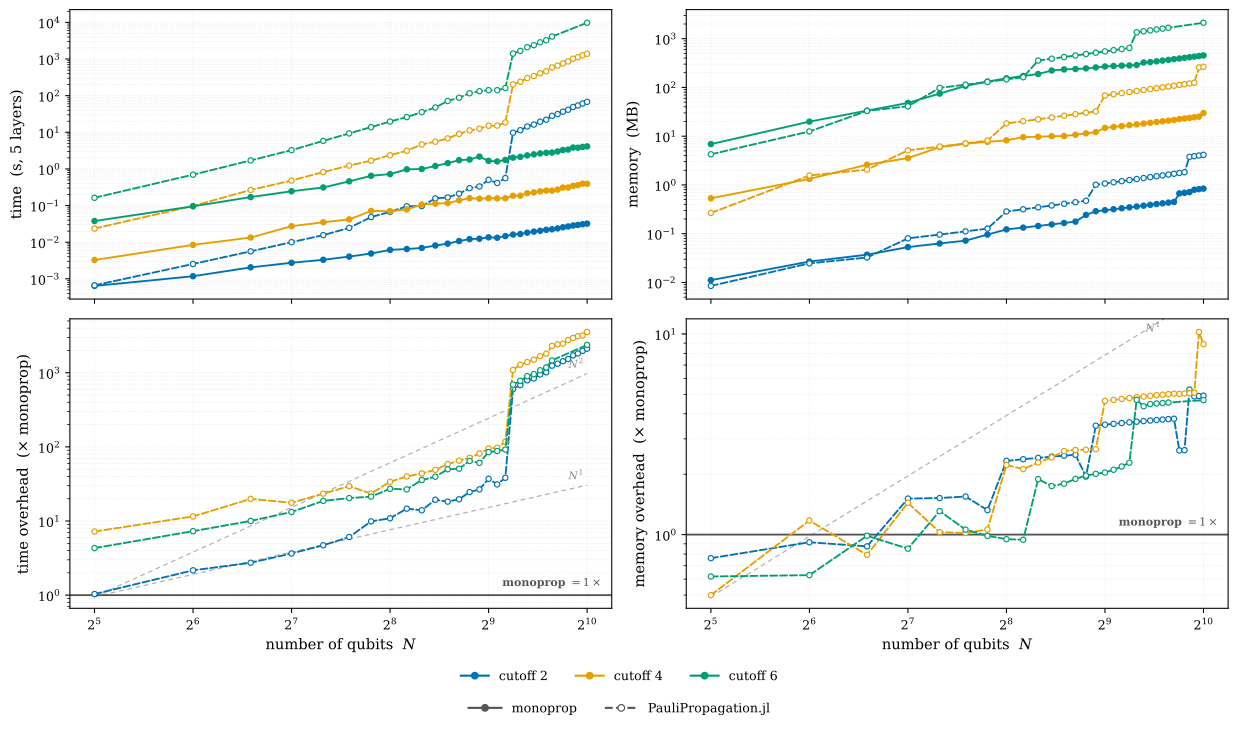 Time and memory overhead of PauliPropagation.jl over monoprop. All points are single-threaded runs on the Leonardo supercomputer.
monoprop scales beyond a single compute node, a feature not available in other packages.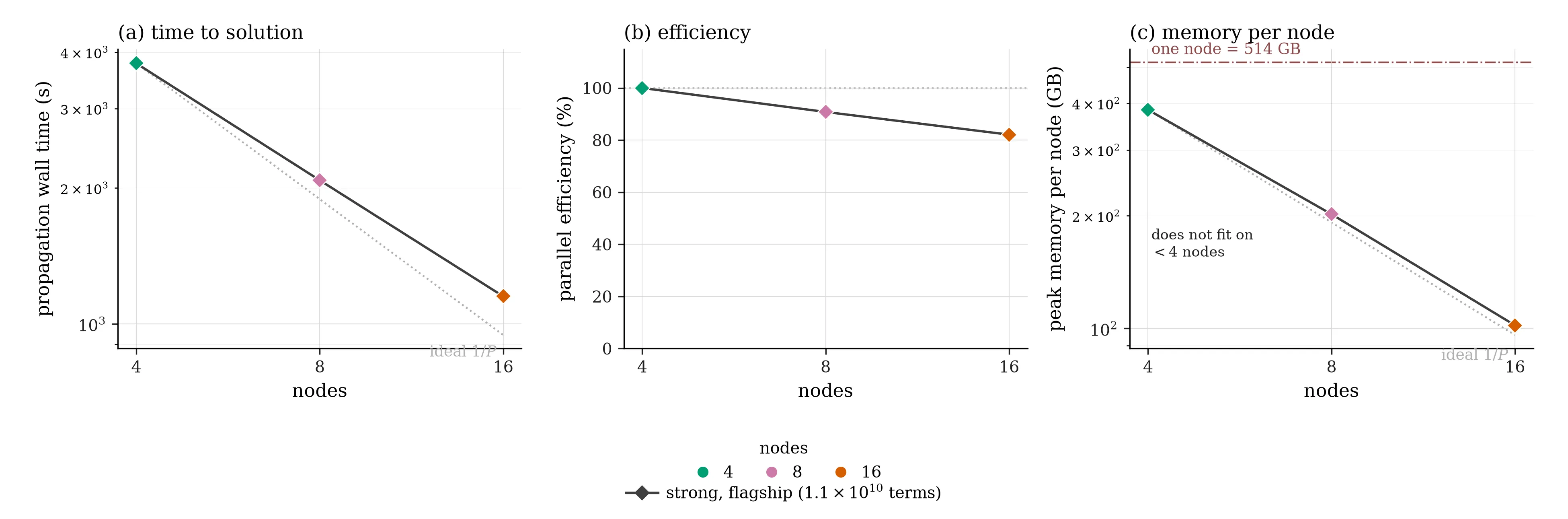 Multi-node strong scaling of monoprop. Data obtained from runs on the Leonardo supercomputer.
Benchmarks
We benchmarked monoprop against other open-source engines on identical problem instances. This section highlights the performance gains monoprop enables on two paradigmatic examples.
On Pauli propagation, using a Trotterised 2D transverse-field Ising model, monoprop tracks the GPU-accelerated cuPauliProp closely while running on CPU, and is faster and more memory-efficient than the other CPU engines we tested (PauliPropagation.jl, QuEra’s ppvm, and Qiskit’s pauli-prop) as the operator grows.
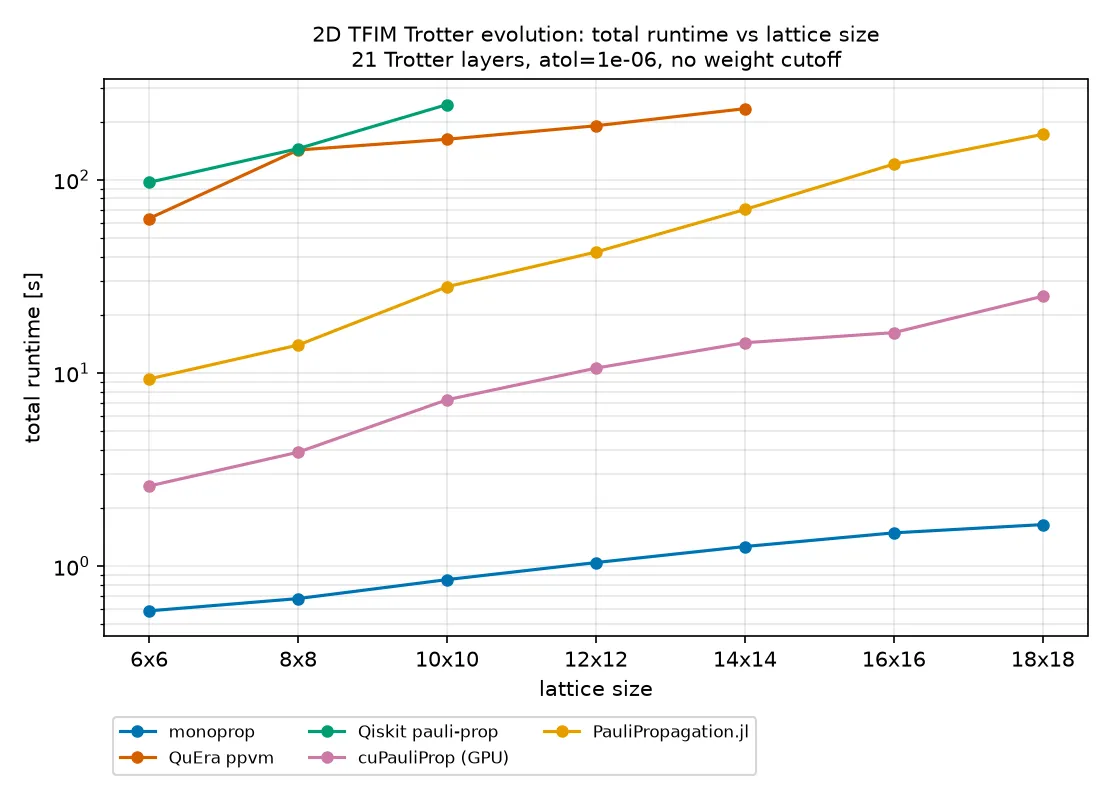 We ran all benchmarks on the Leonardo supercomputer. monoprop, 56 threads; PauliPropagation.jl, 28-thread (its optimum); ppvm and Qiskit pauli-prop propagate on a single core. cuPauliProp used one A100-64GB GPU. Missing points mean that the backend did not finish within the 300s walltime or ran out of memory.
On Majorana propagation, using the 1D Fermi-Hubbard model, monoprop and MajoranaPropagation.jl produce matching term counts and overlaps, which confirms both engines model the same physics. monoprop runs faster and uses less memory as depth and system size increase.
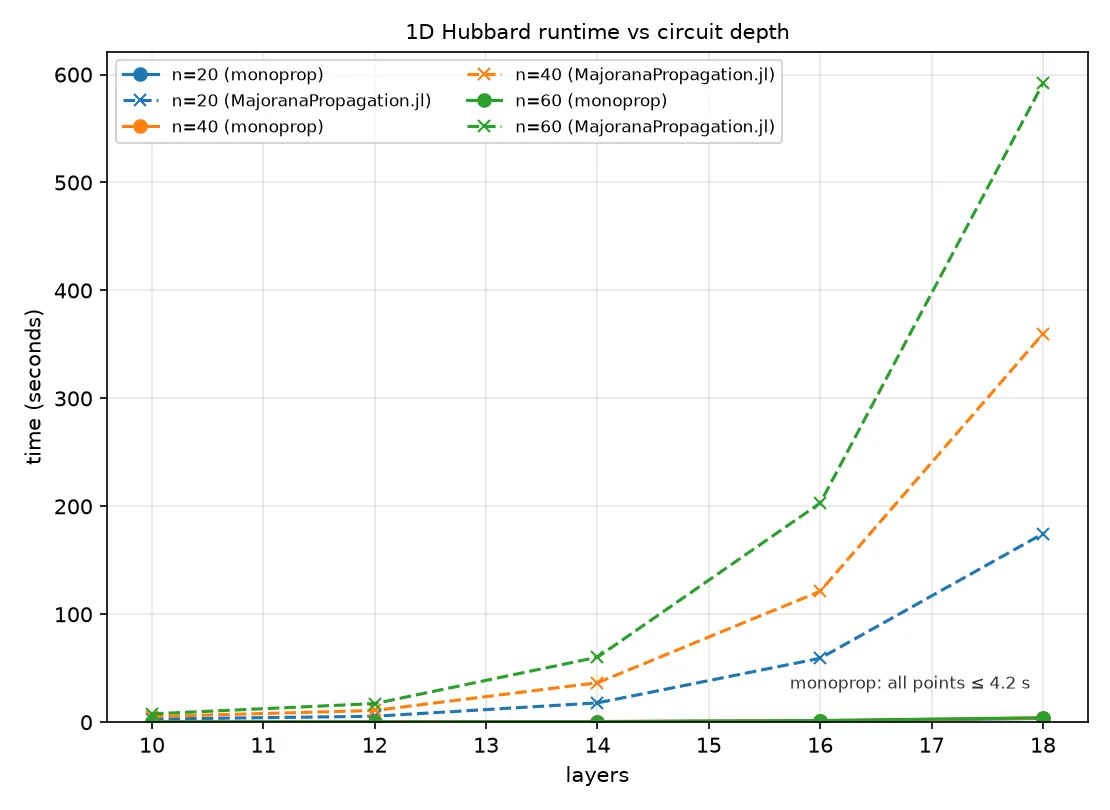 We ran all benchmarks on the Leonardo supercomputer. monoprop, 56 threads; MajoranaPropagation.jl, 28-thread (its optimum).
The benchmark scripts, settings, and hardware specifications are available in the repository, and every figure is reproducible. Head over to our benchmarking page for the complete details.
Benchmarking for quantum advantage
One of monoprop’s tutorials reproduces the 60-site 1D Fermi-Hubbard dynamics from a recent digital-quantum-processor study (Hartnett et al., arXiv:2605.04025), showing how efficiently the package can handle a demanding benchmark from the quantum-hardware literature.
monoprop runs the full simulation in about ten to fifteen seconds on a laptop. The expectation value rises as hopping spreads electrons through the chain and relaxes toward its thermal value, and the count of active Majorana monomials shows where the classical cost is spent.
While we report this without a broader claim, we believe our results show that monoprop for specific problems demonstrates that classical methods reach further than is often assumed, and mapping where they stop is a useful way to identify the problems for which quantum hardware will matter.
Try it
monoprop is open source and available now.
- Install:
pip install monoprop - Documentation, tutorials, and benchmarks: docs.monoprop.algorithmiq.tech
- Source and issues: github.com/Algorithmiq/monoprop
- The method: arXiv:2503.18939
The package is under active development and we build in the open. We hope monoprop helps researchers explore harder chemistry and many-body physics questions with practical, reproducible tools, and opens new ways to study the quantum systems that matter for science.


